It only took a hundred years for this technology to truly take hold for the average person, but they sure understood what it would mean:
DEVICE NOT IN DEMAND
Some Objections to Proposed Telephone Attachment.
A man in Portland, Ore., has invented a telephone attachment that will enable the person at one end of the wire to see the face of the one at the other. He calls this an improvement, and seems to think it fills a long-felt want.
If this fiendish device should find its way into general use the telephone would become a thing of terror. How could you express your opinion of Central with her scornful eyes staring into yours. How could you tell a dun that you had gone to Boston if he could look at your face while you said it? How could you escape a bore in the recesses of your club if he could catch you face to face on a wire?
The world owes something to modern science, but the inventors of wireless telegraphs and portrait telephones are overdoing things. In the interest of the disappearing right to privacy they ought to be kindly but thoroughly suppressed.–New York World
Today, we carry a combination wireless telegraph and portrait telephone (also a motion picture camera, instant newspaper, cartographic archive, and wire recorder, among many other features) in our pockets and think nothing of broadcasting our face to the other end of a telephone call. Well, many people. I don’t Skype, or Facetime, or Snapchat, or whatever the next fun technology for communication both voice and face in a single message will be called. Sure, it took better than a century to finally fill that long-felt want, but I agree, it’s overdoing things.
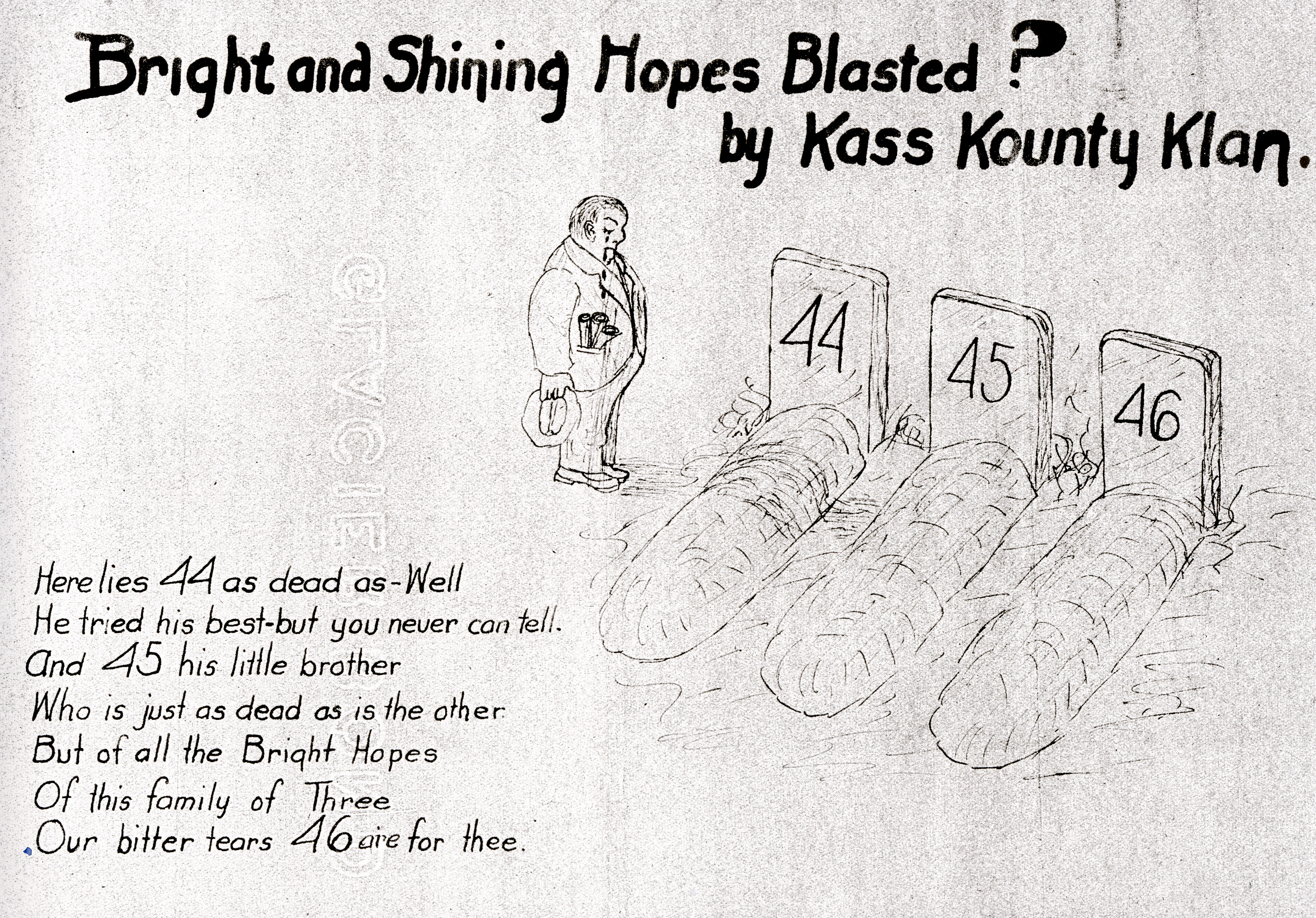
It’s titled “Bright and Shining Hopes Blasted? by the Kass Kounty Klan.”, and the poem reads:
Here lies 44 as dead as Well
He tried his best-but you never can tell.
And 45 his little brother
Who is just as dead as the other
But of all the Bright Hopes
Of this family of Three
Our bitter tears 46 are for thee.
As you might guess from the group’s name, the Kass Kounty Klan was an ‘affiliate’ of the Ku Klux Klan, the US-born racist group that has been stubbornly causing trouble since the 19th century. The North Dakota arm of the group started in the mid-1920s, and quickly grew to a political influence in the region. By the 1930s, though, their power had faded and they remain a footnote of sad history in North Dakota.
Martin served in the state Congress in the late 1920s and early 1930s, so he came in towards the end of the Klan’s presence in North Dakota — at first, I assumed the image above was threatening in some way; combining the Klan with imagery of graves would seem to be a warning to their enemies.
By 1927 or so, the Kass Kounty Klan had lost steam: their northern counterparts in Grand Forks had gotten members elected to positions in government, but the Kass Kounty Klan never saw that level of support. In less than ten years, the group had disbanded, and I interpret the page above not as a threat, but as a requiem for the group late in its life. It could also be a satirical piece written by someone opposed to the Klan.
44, 45, and 46 are legislative district numbers in Cass County — they’ve moved around a bit over time, I couldn’t find a map for the 1920s, but those three districts have traditionally been Fargo state legislative districts. Happily, this comic shows the Klan’s political efforts as dead and buried. as it should be.
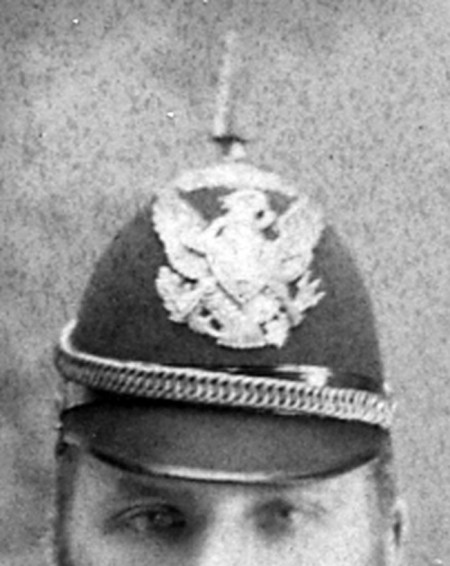
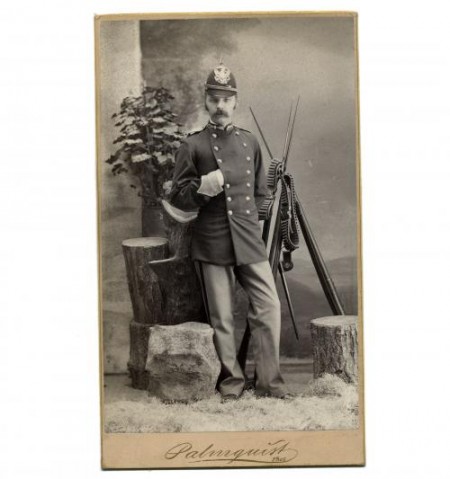
Today’s Dakota Death Trip has a striking soldier in uniform for the Sunday photo; he may seem like the wrong sort of image to post for Memorial Day weekend. Thick mustache, guns stacked to the side, and the kind of helmet the Kaiser would praise a solder for keeping in good shape.
That iconic helmet induces people of the 21st century to remember trench warfare, the earliest of tanks crushing everything in its path on the Western Front, and America’s mortal enemies wearing little close-fitting helmets with spikes on top.
Looking back at an earlier time through the filter of modern day has its pitfalls: it seems like every couple days the internet realizes the swastika wasn’t originally a symbol of fascism and genocide. We see the above photo as the enemy, because one of the most destructive wars ever fought was against an army of helmets like this. However, that was all in the 1910s, due to political strife of the time, the terrorism of anarchists fighting against the empire swallowing their smaller nations, triggering a war that spanned a continent. When this photo was taken, America wasn’t shipping our doughboys ‘over there.’ German immigrants were flowing into the midwest, inspiring the railroad to name a fledgling frontier town after German Chancellor Otto von Bismarck, eventually becoming the state capitol.
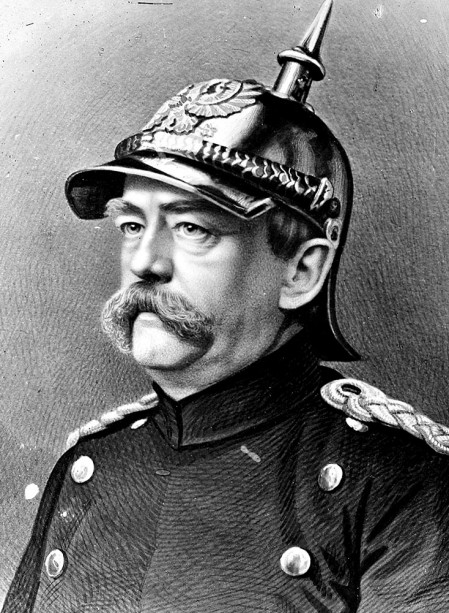
The spiked helmet is known as a pikelhaube, and while it did have its origins in the Germanic regions of central and eastern Europe, there’s nothing sinister about its origins. Today’s military uniforms are plain and functional, and that change was slow and started in the 19th century. Military uniforms were a symbol of power, a demonstration of a country’s military strength, and the pikelhaube was an iconic part of those uniforms.
As is with other aspects of fashion, various designs similar to the pikelhaube spread through other militaries around the world, including South America, Russia, and Scandinavian countries. The British Horse Guard still wears them, in polished metal, and the design is still present, if you know what you’re looking for, in the traditional bobby helmet. And, as a young country not wanting to buck popular fashion trends, the US military adopted it as well.
The pickelhaube first was worn during the Civil War, by German militia regiments; the militias were self-contained units, not affiliated with the standing US Army, so they were able to design their own uniforms. The militias also pulled from their local communities, which were often of similar ancestry, so a more German region would choose to base their uniforms on the ones they would have work back home. In this case, they adopted the pikelhaube.
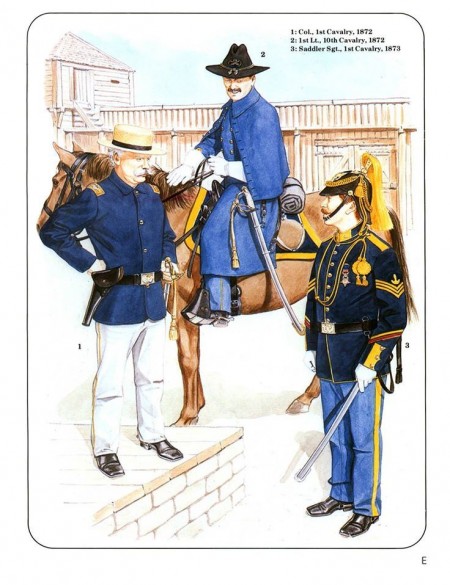
This wasn’t a one-off uniform for the Civil War, honoring the homeland; as the pikelhaube spread around the world, the US Army also adopted it as part of the standard uniform through the 1870s and 1890s, although most modern document credits the British calvary as the inspiration for the American helmet, rather than anything German. Let’s take a closer look at our man’s helmet insignia:
That is clearly the traditional American eagle: shield on its chest, holding an olive branch of peace in one claw and arrows of war in the other. This looks like the M1881 helmet (as opposed to the M1872, which does look more British), and the braid would seem to indicate an officer.
I couldn’t definitively identify the coat our helmeted gentleman has on, it doesn’t look standard nor does it show any rank to indicate an officer. The standing collar has a number “1” on it, which could indicate either the 1st Cavalry or 1st Infantry — or, this is possibly a militia uniform, designed after the US Army uniform but given their own unit personality.
So, Dakota Death Trip’s photo today isn’t one of the enemy, or of a German fighting for his empire — but an American soldier, the kind of which we honor on Memorial Day.
One thing the internet both rewards and hates at the same time is when someone reposts something, without crediting the source, as their own fresh content, under an alias. Reddit has an entire culture revolving around it. Copyright defenders try to point out that just because something’s on the internet doesn’t mean it’s free, but it falls on deaf ears at every corner. People use aliases to cover up their duplication, with little regard to taking much claim of their stolen content, other than to reap the attention, upvotes, and thumbs-ups in the fallout.
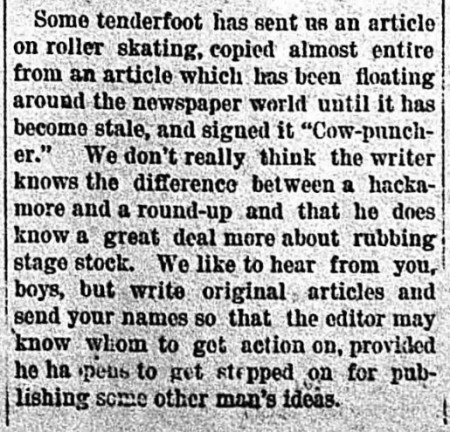
Sadly, this isn’t something new: it has been going on for more than a hundred years. From The Bad Lands Cow Boy, April 16th 1885:
Some tenderfoot has sent us an article on roller skating, copied almost entire from an article which has been floating around the newspaper world until it has become stale, and signed it “Cow-puncher.” We don’t really think the writer knows the difference between a hackamore and a round-up and that he does know a great deal more about rubbing stage stock. We like to hear from you, boys, but write original articles and send your names so that the editor may know whom to get action on, provided he happens to get stepped on for publishing some other man’s ideas.
I couldn’t figure out what “rubbing stage stock” meant, but it must be an uncowboylike task the way it was accused upon the alias-hidden copyright-infringer.
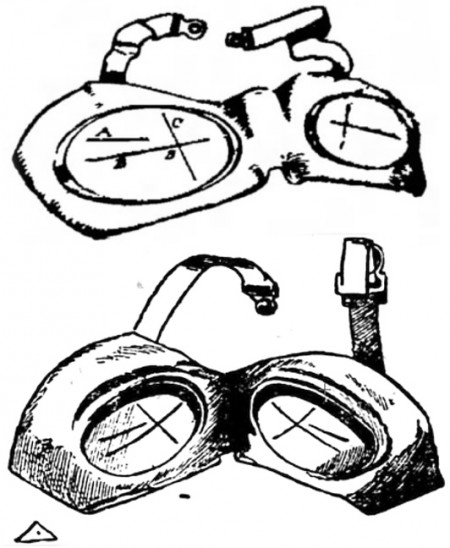
“Looked at from the distance of two or three feet away these plates appear to be solid and that by no means could the eyes see through them. But a closer inspection discloses (A, B, and C) in the smooth surface of the steel. They are in the form of a cross, with an additional shorter line above. These lines are cut through the steel plate, and when the goggles are properly adjusted to the eyes of the person wearing them can see in all directions through these narrow slits as well as if they were an ample surface of glass.”
It might seem counterinuitive — who can see through a tiny slit? — but what they’ve essentially created is a stenopaeic slit, a device used by opticians to detect astigmatism by filtering incoming light through what’s essentially an elongated pinhole camera. Based on the direction of the line, and whether the eyesight through the slit in one direction versus the other, can tell how malformed the lens is.
Technically, someone with good eyesight should be able to see through the slits fine — and the French optician who designed these lenses made a horizontal and a vertical one, to allow some eye movement. I don’t entirely get what the “A” line is for; my guess is for a modicum of peripheral vision. One thing these googles do not take into account is the movement of the eye when looking around; there may be some limited vision when just moving the eye from right to left, or up and down, but when doing so the pupil and iris are moving in orbit around the center of they eye, which doesn’t translate well compared to a flat surface. Wearing these googles means looking straight ahead for the best benefit, which I suppose is generally how driving is done. They may work OK, but I’d be hesitant to operate a moving vehicle with these in front of my face.
The technique found a resurgence during wartime as a means of protecting the eyes from shrapnel, since glass lenses pose a problem when struck by a small piece of metal at high speeds. Owing back to the science behind the stenopaeic slit’s optical origins, the style was refined over the years and is now the snake-oil vision-enhancing product called “pinhole glasses“. Pinhole glasses are believed to cure poor eyesight, for which there is little-to-no evidence. The original steel googles purported to cure “swelling and conjuctivitis”…which I can only assume is due to keeping stuff out of the eyeball, versus any special scientific principle.
The “snake oil” link above also warns that driving while wearing the pinhole glasses is a really, really bad idea. But, if you had tried these glassless goggles out, a hundred years ago, you’d already know that.
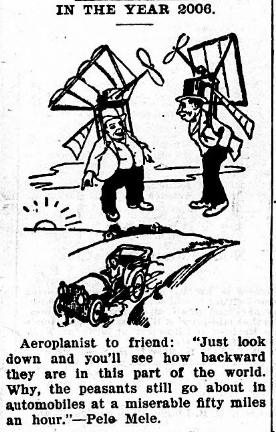
The promise of flying cars and jetpacks in the 21st century has been around a long, long time: here is a comic from the french journal Le Pele-Mele:
IN THE YEAR 2006
Aeroplanist to friend: “Just look down and you’ll see how backward they are in this part of the world. Why, the peasants still go about in automobiles at a miserable fifty miles an hour.”
This was found in the 2 August 1906 edition of the Williston Graphic; note that the Wright Brothers made their first flight in December 1903 — a mere three years later, speculation had already grown to the point where, a hundred years hence, there would be no question that only backwards, primitive societies would resort to driving…ick…automobiles. They were just as wrong about the lasting power of the stovepipe tophat as they were about personal flight systems.
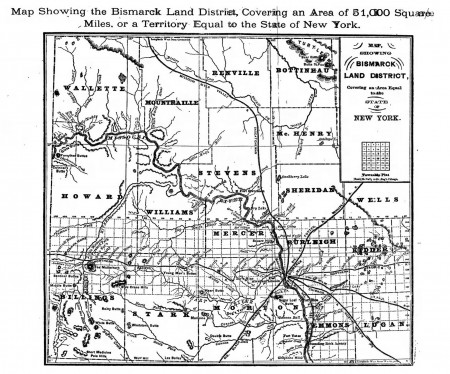
Click on this map to see a bigger version. In 1881, eight years before statehood, this is how the county lines were drawn in north-central North Dakota:
Your first question if you’re familiar with this area is probably “Where’s Ward?” Ward, home to the city of Minot, is one of the most populous counties in the state but just a few years before statehood Minot didn’t show up on maps and the county didn’t exist.
Ward County was created in 1885 and named after the chairman of the House of Representatives Committee on Counties (how convenient). Portions of Stevens, Renville and “Mountraille” were merged to create what is today known as “Imperial Ward” County. Imperial Ward was the largest county in the state until 1910 when it was broken up, reforming Mountrail and Renville and adding Burke County to the north, and leaving a much-smaller Ward County to the south. From the 7/15/1881 Bismarck Tribune.
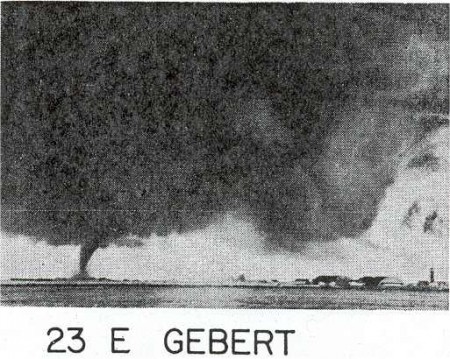
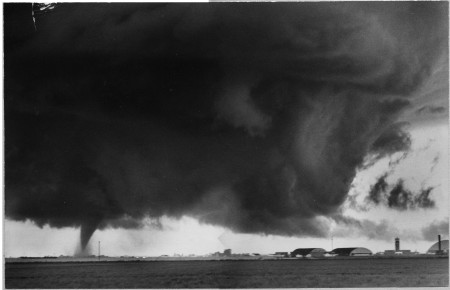
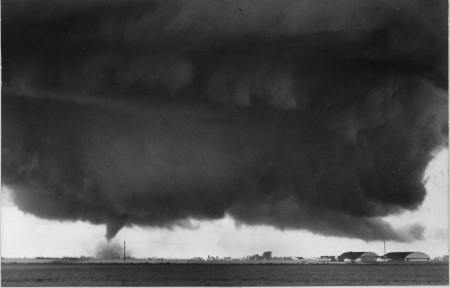
If you’re even somewhat familiar with the Fargo tornado of 1957, you recognize this photo – it’s been in newspapers, it’s part of the Fujita report on the tornado, and it even appears on the NOAA website:
30-year-old Chet Gebert was one of the Fargo Forum‘s staff photographers. Just after 7:30pm on June 20th, 1957, heavy storms rolled into the Valley, and while out on his beat Chet pulled in just north of the Star-Lite Drive-In and pointed his camera to the southwest. There wasn’t any Fargodome at that time, no RedHawks stadium, it was fields and empty land as far as you could see…until Golden Ridge, that is.
Golden Ridge had a bad reputation: even when my daughter was in gradeschool, so we’re talking 21st century here, Golden Ridge was seen as a crime-ridden, low-rent, wrong-side-of-the-tracks part of town. It was sandwiched between the Great Northern railroad yards and the old industrial part of downtown Fargo, so back in the early life of Golden Ridge the reputation might have been true, but by the time I was a kid it was a regular North Fargo neighborhood. If you drive west on 7th Avenue north, you reach the intersection of 7th avenue and 25th street — the corner with the abandoned gas station marks the southeast corner of Golden Ridge. I guess the abandoned gas station doesn’t really improve the area’s image much. But, you can easily drive a large square around Golden Ridge: the division between industrial buildings and residential homes is a stark line delineating Golden Ridge.
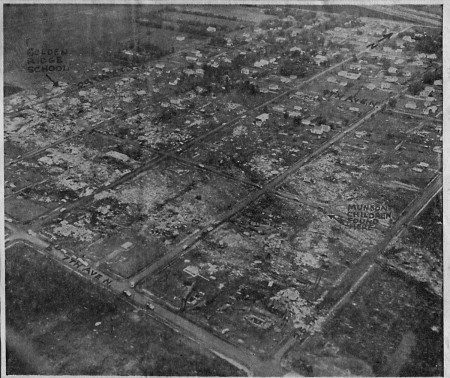
The 1957 tornado was nearly the end of Golden Ridge:
From the Sunday 6/22/57 Fargo Forum
The ‘point’ at the bottom is where the vacant gas station sits today. The Fargo tornado — the third of four spawned by this storm — first touched down further west, about the spot in Gebert’s photos, around where the Fargo Landfill is today. Golden Ridge was its first contact with civilization and it strolled right down 8th Avenue North. Most deaths were along here: first it hit the Tigen house at 718 29th street, just south of the Golden Ridge School, killing Don Tigen and injuring his wife. The tornado killed the entire Udahl family at 802 27th St., and a block east it killed six children at the Munson home, 818 25th Street (marked on the photo above).
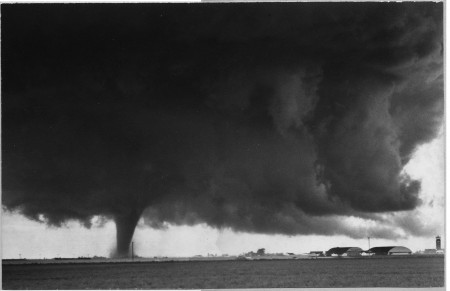
Chet Gebert took several photos of the tornado – here’s about as high a resolution as you’ll ever see of them:
The second photo above is the iconic image that gets used whenever the Fargo tornado is discussed; all three appear in the 6/22/57 Fargo Forum that I’ve got a copy of. The printed-reproduced-dithered-halftoned-and-photocopied-again image doesn’t do justice to the photos themselves. The clouds aren’t a single mass of black: the thunderhead is a writhing mass of wind and rain.
Incidentally, the photo at the top is called “23 E GEBERT” because, in the Weather Bureau report on the tornado, it happens to be the 5th photo from Chet Gebert, and taken at location #23 on the list. The report says over 200 photos were taken of the tornado, and amusingly notes that they got a number of pre-tornado photos of the stormcloud because people, upon hearing the tornado warning, went outside and began taking pictures of the quickly-rotating wall cloud, thinking it was the tornado itself.
With my three copies of the tornado photos, I devoted a lazy Sunday morning to piecing them together into a cinemagraph that, while not a true film of the tornado, gives a sense of scale –
There IS actual film of the Fargo tornado, as seen in this newsreel:
The Weather Service report credits both movie segments to a 16mm film made by a “Jennings” — that would be WDAY’s Harry Jennings from the “top of the WDAY Building” at 205 N 5th street, now the offices of Prairie Public.
All of these pictures and films, particularly the unintentional pre-tornado photos, are the reason the Fargo tornado has had a lasting impact on storm analysis. Tetsuya “Ted ” Fujita wrote “Research Paper No. 42” for the Weather Service, a photo-filled analysis on the Fargo tornado that helped spawn the Fujita Tornado Damage Scale and codified many of the terms used in describing tornadoes today.
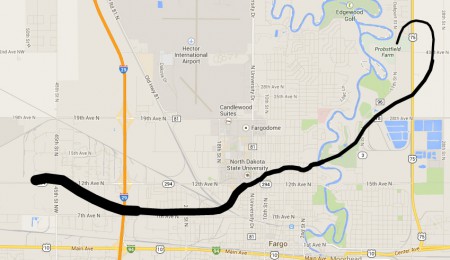
Click for zoomable Google Map of the tornado path
The 1957 Fargo tornado was at its most powerful when it struck Golden Ridge, but it still continued on through North Fargo. It hopped the Great Northern tracks just southwest of the soccer fields and NDSU’s “T Lot”. NDSU was saved due to a slow right turn, which mangled several blocks of residential housing and hit the old Shanley High School building. Then, it marched through the residential area along 13th Avenue North, south of El Zagal, before crossing the Red River and into the, at that time, mostly uninhabited areas around the Moorhead Country Club. It had also lost much of its power by the time it reached the Red, and petered out after crossing Highway 75 twice, before fading near Probstfield Farm.
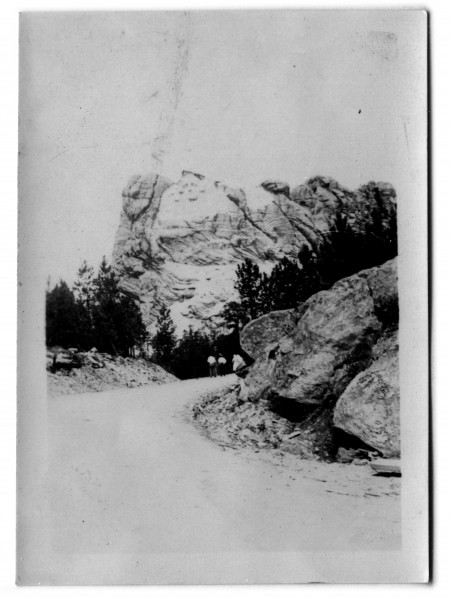
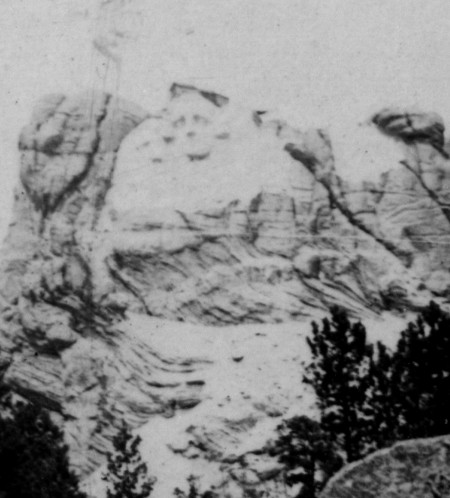
We’ve got a lot of old photos – almost more than we know what to do with. This one is so over-saturated, so light, that I had to really darken it in Photoshop just to see anything, and I didn’t realize what it was at first:
You might be thinking, “Wow — it kinda looks like there’s a face in those rocks! Weird, huh?”
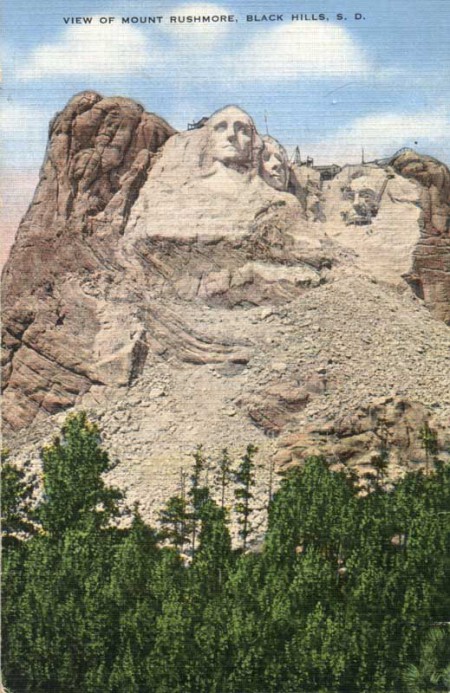
Well, that’s because Gutzon Borglumput a face there: that is several years away from becoming the Mount Rushmore we know and love today — President Washington is only partially done:
Carving started in 1927, and the finished Washington face was unveiled to the public on July 4th, 1934, so that puts this photo somewhere in between, probably 1932 or 1933. Based on this 1932 photo, progress seemed at about the same point, so 1932 is probably right. They didn’t carve all the faces at once — Washington was completed in 1934, Jefferson in 1936, Lincoln in 1937, and then Roosevelt in 1939. About 4 years after the photo above, here’s how much progress they made:
Alongside the glass plate of Sanssouci Palace is this ambulatory image:
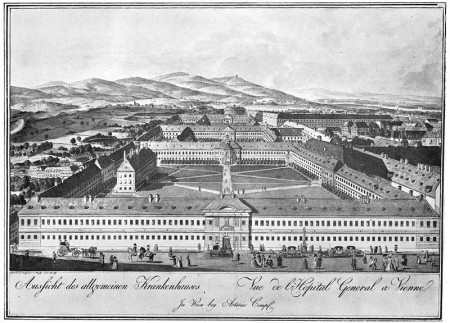
The plate is marked “Hospital Yard, Vienna”. I’m sure there have been many different hospitals in Vienna over the years, but the architecture clearly identifies this building: the Vienna General Hospital, otherwise known as “Allgemeines Krankenhaus der Stadt Wien”. The image above would appear to be taken along that central promenade, facing towards the west; the central building on the right is clearly visible in the background of my magic lantern slide:
The Vienna General Hospital was built in 1694 as a home for the poor and invalid by Emperor Leopold I, and by 1696 it held over a thousand indigent patients. Emperor Joseph II saw the poorhouse as capable of so much more than just housing the sick and poor, and turned the campus into a General Hospital, inspired by Hotel Dieu in Paris. The grounds continued to be expanded unto the 19th century, but as the medical care of the 20th century improved, the old Hospital became less functional.
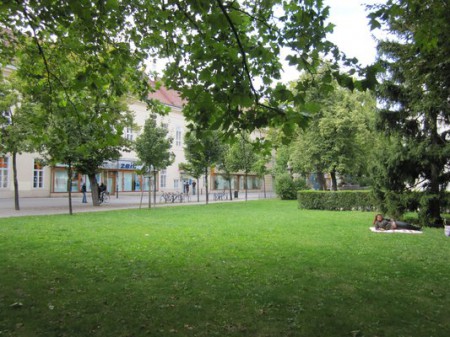
I tried to find a modern photo with the same perspective, but came up empty — not due to a lack of pictures of the grounds, but just the lack of coincidence in pointing a camera that direction. You can look around the grounds in this photoset.
 The
The